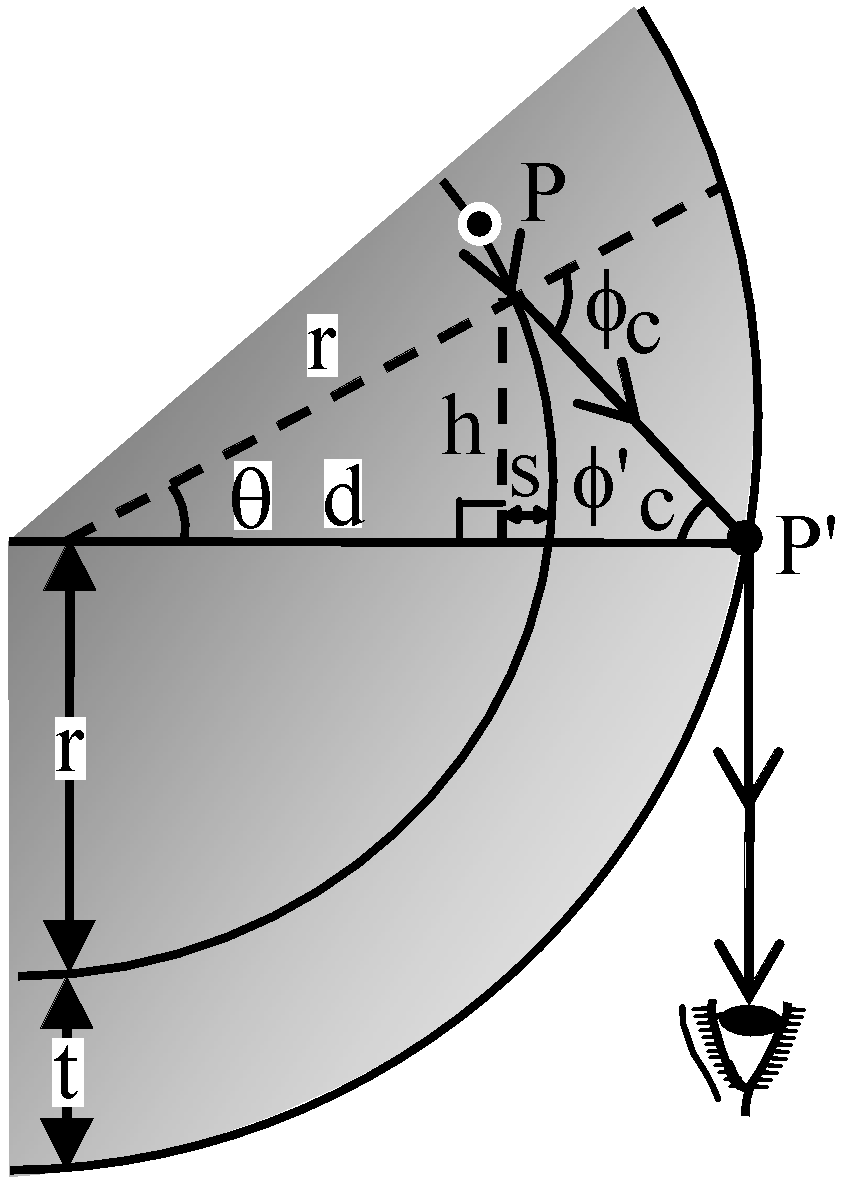
Glass mugs are often made with thick sides, so that they appear to hold more than they really do. When filled with say apple juice it appears to extend all the way to the outer surface of the mug. Fig. shows a view from above of the path of a ray from a point P in the juice at the inner surface of the mug. Take refractive index of glass and juice to be 3/2 and 4/3 respectively.
Text Solution
Verified by ExpertsCHECK THE SOLUTION.
Sol. The figure is drawn so that the ratio of the wall thickness t to the inner radius r is as large as possible. In this case the light from point P appears to be coming from P' at the edge. For thicker walls light from point P would appear to be coming from inside the edge. For thinner walls, light from point P could not be seen from this direction, and light apparently coming from P' would be originating at another point in the juice.
At this point the ray is tangential and will refract at critical angle φ C , in the glass; similarly at P' once again critical angle φ C is formed.
Critical angle at juice-glass interface,
sin φ C =  , φ C = 62.73º
Critical angle at glass-air interface,
sin φ ' C =  , φ ' C = 41.81º
From Δ OPM, sin θ =  … (1)
… (1)
From Δ PMP', tan φ ' C =  … (2)
… (2)
Where S = r – (d + t) = r – (r cos θ + t)
Angle φ C is exterior angle of triangle OPP'.
Hence θ + φ ' C = φ C
θ = φ C – φ ' C = 20.91º
Dividing eqn. (1) by (2), we get
 =
=  = 1 – cos θ +
 =
=  + cos θ – 1
On substituting numerical values, we get
 = 0.33
Actual volume = π r 2 l
Apparent volume = π (r + t) 2 l
Hence  =
= 
= 
= 1.77
Prepare Smarter with CGP Edu
Get practice questions, solutions, and test series in one place.
Write a Review
Share your experience with this question and solution.
Commentary
Send your comment, doubt, correction, or feedback to admin.
Similar Questions
Explore conceptually related problems